
|
|
| April 30 - May 7 |
|
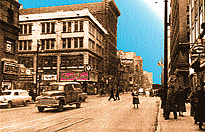
Montreal Montreal today is one of the most important North American entry points for narcotics. There is cocaine from South America, heroin from southeast Asia and marijuana from the Pacific provinces and States. While some stay behind to feed the relatively small Canadian market for drugs, most head south meeting the demand of the worlds largest consumer of narcotics. And its all managed in Montreal by a small group no more than four to five people. "Its a huge ring," confirms Staff Sergeant Jean Pierre Boucher of the Montreal RCMP drug squad. "They fix the price for drugs both wholesale and retail, decide how much must come in and whom it must be sold to," Theres the Mafia boss, the chief of the Irish gang who controls the West End of the Francophone city, and the head of Hells Angels. In Italy this would be known as the "Commission", but in Montreals criminal jargon it is known as the "Consortium". And it has contacts everywhere: in Columbia, the United States, the Bahamas, but most especially Europe. It was a former drug dealer who some years ago confirmed the existence of this "drug coordination board" to investigators. Something like the "junta" that in the Forties and Fifties handled gambling, clandestine bets, prostitution and all the illegal activities connected to show business in what was then called the North American Paris. These are stories of bygone days, investigative craftsmanship, marked by black-and-white photos showing the sneering smile of many untouchable bosses, such as Max Shapiro, Frank Pretula, Louis Greco, and Harry Ship. Gambling alone generated profits to the tune of $50 million per year. And with money, the Montreal crooks bribed everybody, politicians, policemen, and middlemen included. Harry Ship was a drop-out at Queens University. When he was arrested for gambling in the Forties, the police found in his notebook telephone numbers of some of the most influential politicians. There were many rumours about dangerous liaisons but nothing of consequence. Ship soon became the head of the tough guys controlling nightclubs. He was smart, but he had a weak spot: he loved gambling on everything. He once lost $35,000 gambling on a hockey team. And gamble after gamble, he ended up owing his neck to Frank Erickson, a U.S. gangster associated with Frank Costello, a major figure in U.S. organized crime, who was also referred to as the Prime Minister of La Cosa Nostra. Pretula and Greco, two wiseguys from Montreals underworld, did not let the opportunity pass them by. First they went and visited "Lucky" Luciano in Italy, then they went to see Costello in the United States. They had a proposal for both of them: "Should you convince Ship to let us in on his business considering that you hold him in your power, well share profits with you." Costello and Luciano didnt need much persuading. Canada tempted them for two different reasons: Costello saw it as an important market in North America for the clandestine betting business, while Luciano considered it as a nerve centre for drug dealing, which in a short time the Sicilian Mafia was going to control. Ship gave in, and Pretula and Greco became his partners. The team started operations on the premises of a real estate agency. Shortly thereafter Costellos dream came true. La Cosa Nostra landed in Canada. The Italian Direzione Investigativa Antimafia (AntiMafia Investigation Directorate) sees those years from the point of view of La Cosa Nostra: "The inclusion of Canada took place because of the particular will of the Calabrian bosses affiliated with the New York Mafia, Frank Costello and Albert Anastasia, who wanted to prevent possible disagreements between the Sicilian-American and the Calabrian organizations". Montreal started to teem with nightclubs, striptease shows, gambling tables, barrels full of champagne. It was like a scene out of Sodom and Gomorrah. Frankie Carbo, one of the best-known American boxing promoters of those years, became a habitual patron of Montreal nightclubs, where one could bet on anything. Bets flowed in from every part of North America, a stream of millions of dollars controlled by the French-speaking underworld in association with La Cosa Nostra families. Soon Gil Beckley, one of the most powerful bookmakers in America, Charlie Gordon, known in American football circles, and a certain Lealow, a bloodthirsty killer already convicted in the U.S. for several murders, showed up in Montreal. These were tough guys, ready for everything. It was then, in 1952, that Costello decided to send Carmine "Lillo" Galante to Canada, a ruthless killer and the author of dozens of murders, including that of Carlo Tresca, an antifascist who had founded an Italian weekly magazine in New York which criticized Benito Mussolini. In Montreal Galante began operations under the guise of a trading company, I&P Electrical Products. Pretula and Ship were the strong arms of the organization, those who enforced order and slipped hundred-dollar notes to the cops. Soon enough extortion began; "protection" was universally imposed. Galante had Earl Carluzzi, an ex thief, came over from New York with the task of organizing the union of hotel, restaurant and nightclub staff in order to control labour. Like with construction workers. Anybody willing to hire staff had to go to Carmine Galante. In 1954 the Brooklyn toughguy had become a Montreal big shot, a "mammasantissima" (boss of bosses). However, guys and dolls were not alone. There were also those who tried to take criminals out of their niches. Inspector Bill Fitzpatrick was one of these. He commanded the investigation squad of the Montreal police and understood that bank cheques were to become the fingerprints of the future. He immediately noticed that something was changing. The confirmation arrived some years later when, during a search at Pretulas home, the police found a notebook with all the figures (almost $100,000) invested by the Mafia to finance the campaign of a Reform candidate who had challenged Jean-Paul Drapeau during the administrative elections. Pretulas payroll included the names of six opinion-makers and a radio journalist who had accepted money for discrediting Drapeaus campaign. "When he learned of the discovery of the notebook," tells one of the gangsters friends, "Pretulas face became white as a sheet". He would have done anything to take back that notebook, which was so hot and compromising. That same year, the former vice chief of the Montreal Police, Pax Plante, denounced connivance between uniformed officers and the bosses. An investigation led by Justice François Caron followed: 20 police officers were arrested and subsequently convicted, including Chief Albert Langlois and his predecessor Fernand Dufresne. Other commissions, other reports, dating back from the turn of the century, had exposed the corruption in law enforcement circles. A special commission chaired by Henri-B. Rainville conducted the first investigation in 1894, but with little results. Another one, urged by a citizens committee, was opened in 1909 and entrusted to Justice Lawrence John Cannon. A lot of words, but very few facts. The years following Drupeaus election were difficult even for Pretula, who was increasingly disliked by Galante. Carluzzi went back to the United States carrying with him all the unions funds. And Louis Greco, a powerful Sicilian mobster, started to make room for himself in the underworld, attracting the attention of La Cosa Nostra. At the same time also Vic Cotroni, an ex carpenter who had fought on the ring as a wrestler, and his brother Peppe, one of the first big drug dealers in Canada, started taking their first steps in criminal enterprises. Galante entrusted them the task to expand his influence all over Quebec. Somebody reached the end of the road. In 1955 Pretula, wanted by the police for tax evasion, disappeared. Somebody said he had decided to leave Canada and move to the West Indies or South America, but investigators never ruled out the possibility that he could have been killed and dumped in the icy waters of the St. Lawrence River, the final destination for many Quebec mafiosi. The RCMP had foreseen the moves of La Cosa Nostra. In Ottawa someone took notice of the 1940 declarations of Burton Turkus, vice district attorney in Brooklyn, who had uncovered an organization that made business in the United States by using violence as seed capital. The Kefauver report had also not gone unnoticed, with its confirmation of the existence of a nationwide crime syndicate with a turnover superior to those of General Motors and Standard Oil put together. The Mounties started to track Galante after his arrival in Montreal, and in 1956 forced his brother-in-law, Tony Marulli, to leave Canada under the threat of arrest and expulsion. But they couldnt stop the tide of dirty money that was to turn Canada into a branch of the biggest multinational criminal organization in the world. In the summer of 1964, Joe Bonanno, one of the founding fathers of La Cosa Nostra, also tried to obtain permanent residence in Canada. He submitted to the Immigration Office a letter by Giuseppe Saputo who offered him to become a partner in the management of his dairy business in Quebec. Since then Canada has never ceased to be a rotating door to mafiosi, a kind of Grand Hotel for criminals. (Translation by Emanuele Oriano) Antonio Nicaso is the author of Deadly Silence: Canadian Mafia Murders and Global Mafia: The New World Order of Organized Crime (both published by MacMillan Canada). |
||||||||||||||||||||||||||
|
Part: 1 / 2 / 3 / 4 / 5 / 6 / 7 / 8 / 9 / 10 / 11 / 12 / 13 / 14 / 15 / 16 / 17 / 18 / 19 / 20 / 21 / 22 |
 |