
|
|
| October 15 - October 22 |
|
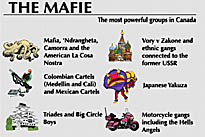
Even Americans have begun to raise their voice: the FBI first, then the Permanent Subcommittee of the Senate on Organized Crime. Theyre angry at Canada because it does not manage to make life difficult for mobsters, or to adequately patrol its long border with the U.S. While in the United States the gangs are in a tight spot, north of it they are prospering undisturbed. From time to time someone ends up in jail, but few rejoice. "The situation is worrisome," wrote the CSIS, the Canadian Security Intelligence Service, mentioning at least 18 criminal organizations operating here: from British Columbia to Quebec, passing through Alberta, Manitoba and Ontario, all the way to the Atlantic provinces. Some weeks ago, Raymond Mercier, Assistant Commissioner of the RCMP, hinted at the possibility of cutbacks for countering budget shortfalls. These could jeopardize investigation nuclei at the forefront of the struggle against organized crime. The Solicitor General, Lawrence MacAulay, could very well not exist. Since he replaced Andy Scott he never uttered a word about the problem. We tried to interview him; we sent him written questions, but all to no avail. Other newspapers tried as well, with the same lack of success. However, the fault is not entirely MacAulays. It is the whole Chrétien cabinet that keeps underestimating such a dangerous phenomenon as Mafia-like criminal organizations. Theres no law against criminal associations, nor adequate laws against financial crimes. Some time ago I met with Sergeant Mark Bourque of the Montreal RCMP. He told me about the misadventures encountered during Operation Pilgram. Bourque was on the tracks of a powerful organization that in a couple of years had deposited more than 30 million dollars in cash in some Canadian banks. When he tried to shed some light on that whirlwind of money he was met with endless miles of red tape and infinite difficulties. He was treated as if he were a nosey intruder instead of a detective hunting down the dirty trail of money. The same happens in high finance circles: stock markets often make good hunting grounds for Mafia middlemen. There are no controls, and anything goes, including introducing huge amounts in cash. As an Italian National Anti-Mafia Deputy Prosecutor, Dr. Alberto Maritati, quoted in an interview we published on this same page, with tools like these the struggle against organized crime becomes wishful thinking. There are, however, signals of encouragement, and underestimating them would be wrong. Public opinion in the last few years reflected preoccupation with the dangers behind the phenomenon. A survey carried out by the Angus Reid Group Inc. on behalf of the Solicitor General showed that people would like the government to do much more about this. But the government, for the moment, keeps silent. Ben Soave, the chief of the task force against organized crime in the Greater Toronto Area, is right in remarking that this phenomenon must be looked at in the face. The risk is enormous. Criminal organizations, especially in North America, no longer use intimidation by force to establish control over the territory. They use their profits to condition the legal economy. Some organizations are even trying to infiltrate the States nerve centres, using corruption as a weapon. What can we do, before it is too late? We can only use words. We can denounce the politicians deafness about this subject and remind everybody that we should not lower our guard. Our silence will never be an accomplice. "The phenomenon is spreading" BEN SOAVE Canada is becoming a land of opportunities even for criminals. Do you wonder why? "Because it offers many guarantees. Its a country with a very stable economy, with banks that have branch offices in the Caribbean countries, and historically it has no anti-organized crime mentality. Canada has always tried to establish a trustful relationship with its citizens. But in a big country like Canada, not everybody is trustworthy. Theres always someone who tries to take advantage of this." Nowadays, is the situation more or less worrisome than five years ago, when nobody at the politicians level perceived this phenomenon as a threat to social security? "More worrisome. Five years ago we had no global knowledge about it. For instance, we knew very little about criminal organizations linked to the former Soviet bloc. In the last few years our workload has increased enormously. At the same time, our budgets were severely curtailed." How is it possible to fight Mafia-like criminal organizations without adequate laws? "Ive been wondering about it for some time. We are trying to obviate this great problem by relying heavily on national and international cooperation among police forces. The lack of adequate laws often hampers our performance. We could do a lot more." Using Italy and the United States as references, what would you like in your struggle against organized crime that these two countries already use? "For sure the U.S. RICO and the Italian Anti-Mafia Law, two effective tools that have given important results. But it would be advisable to revamp our own laws in regards to the effectiveness of sentences. Twenty years should mean 20 years, as they do in the United States. In fact, I think our anti-gang law is quite ineffective. It is the fruit of an emotional response. It was introduced to counter biker gangs that in their war over Quebec had killed some innocent people, people who had nothing to do with their feuds. We would need something more concrete, more rational, instead. The anti-gang law, designed against bikers, was never applied against other organizations. And this proves its effectiveness." Even in Canada there are now turncoats who are collaborating with the justice system. In your opinion, do they represent an advantage in the struggle against criminal organizations? "Of course, they are a great advantage. They often confirm investigative intuitions and help us to understand complex situations, situations that are difficult to comprehend from the outside. But we must be very cautious with them. Everything they say must be verified. Not once, but 10 times." There are criminal organizations that are trying to get in touch with several political institutions. Do you think these are occasional episodes, or is the situation more serious? "There are some Mafia-like criminal organizations, such as the Vory v Zakone or other groups from the former Soviet Union, that cannot live without political, police, and entrepreneurial connections. It is a part of their operating procedure. In the past this was occasional, now the phenomenon is spreading. We suspect that there are corrupt politicians and even police officers, but finding evidence is difficult." Are you optimistic? "I cant avoid being optimistic. Now the people, and the media themselves are starting to become aware. Their reaction will become a pressure. And lawmakers will be unable to underestimate or tolerate this growing threat any further." "Wishful thinking" ALBERTO MARITATI From the outside, Mafia-like criminal organizations in Italy seemto be in a tight spot. Is this really so, or is it just an impression? "In the past years there was an extraordinary effort by the police and investigating magistrates that gave important results. We managed to contain the excesses of the criminal organizations, dealing hard blows to the terrorist wing of the Mafia. But we havent won the war." It took two massacres for the Italian state to intensify its response to the Mafia, at least on the level of repression. Why? "The Capaci and the Via DAmelio massacres (where prosecutors Falcone and Borsellino were killed) represented the apex of a degenerative situation, composed of connivance between criminal power and political power. There were laws that had been passed under Mafia conditioning. Institutions were polluted. We had to react. And all the wholesome parts of society played an important role in the creation of a sort of anti-Mafia conscience that made itself heard in the most important moments." We are now moving towards Mafia partnerships. In Italy, but especially abroad, we see forms of criminal partnership with increasing frequency. In your opinion, is there a global direction, as some collaborators revealed and as National Anti-Mafia Prosecutor himself, Pierluigi Vigna, is convinced? "I dont believe in the existence of a Super-Commission. Theres no need for it. The strength of Mafia-like criminal organizations far from their places of origin is not intimidation any more; it is profit. Therefore, instead of a Supercommission we should talk about operational agreements among different organizations, criminal holding companies managing joint businesses, but with no organic relationship. Theres a sort of criminal solidarity, but its not a value, its a convergence of interests. We must also say that recently the level of conflict among different criminal organizations has greatly diminished." Lets talk about Canada. Is it possible to fight against Mafia-like criminal organizations without adequate specific laws? "Its wishful thinking, with no real prospect. We cannot leave this task to a few police officers and some judges. This way Canada risks becoming a haven for imported criminals, a primed bomb. Then it will be difficult to eradicate them, and the risk for democracy will be enormous." What should we expect, what will the Y2K Mafia be like? "Mafia-like criminal organizations will attempt to control the legal economy. If the State fails to assume control of the territory, i.e. to make institutions work, the mobs will try to take its place, as the Mafia does in many places in Southern Italy. Criminal organizations are increasingly international, they form alliances. It is absurd to think that single States can cope with these new realities. We need to adopt a coordinated strategy, based on alliances among the states. Criminals know no borders, they come and go as they please. We often get caught up in a web of norms, jurisdictions and competencies. This is the most important challenge we have to overcome. If we shall be able to close this gap then maybe we shall give effective replies on the level of repression. But in order to do this, first and foremost we must have the political willingness to do so." (translated by Emanuele Oriano) |
||||||||||||||||||||||||||
|
Part: 1 / 2 / 3 / 4 / 5 / 6 / 7 / 8 / 9 / 10 / 11 / 12 / 13 / 14 / 15 / 16 / 17 / 18 / 19 / 20 / 21 / 22 |
 |