|
Feb 5,2006 - Feb 12,2006 |
Ancient Rome comes to life
Virtual archeological Exhibition displays landscapes and objects at Mercati di Traiano
By Cristiano Camera
Originally Published: 2005-10-23
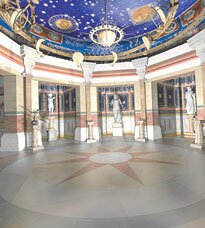
Finally a time machine. Go to the Mercati di Traiano and you'll see something you'd never dreamed of seeing in this third millennium. Two gladiators from ancient Rome are fighting two feet away, in the same arena you're in right now. You can reach out and touch these fighters, or perhaps dangerously be caught up in their swordplay. Or perhaps you can take a stroll, peacefully, through splendid painted rooms of Domus Area, and admire the ceiling, or slightly touch the statues and columns that surround it. You know you're not in a movie because if you go behind the screen you'll see only a huge white sheet, while here you walk around people you meet or the objects and, miracle of three-dimensional technology, you can see them from all sides. Through 2000-year-old eyes, a veritable citizen of Rome, as the exhibition Imagine Ancient Rome, purports to do. The exhibition, the first virtual archeological one, runs until November 20 at Mercati traianei.
Multimedia technology, computer graphics, robotics and virtual realty bring ancient Rome, its empire and its history to life. Beginning with the landscape and historic objects, virtual archeology recreates with the help of technology that which is known and is imagined. The projects exhibited include 50 realizations and encompass in a multidisciplinary manner vast portions of the ancient world. Rome is at the centre of the exhibit with projects and reconstructions that concern the Coliseum, Foro Romano, Teatro di Pompeo, Domus Aurea, Palatino, Terme and Mercati di Traiano. The suburban area of the empire is represented by Appia Antica, Pompei, Villa Adriana, and Teatro di Aspendos in Turkey, and the city of Complutum in Spain. And last, but not least, the world outside of Rome is present through the Parthenon, Cappella degli Scrovegni and the virtual reconstruction of Cimabue's rendering at the Basilica di Assisi. The exhibit's trajectory unravels from the northern wing of Aula to the southern area of Mercati with several stops featuring experimental installations along the way. "Those of Traiano," says director of Museum Systems Fori Imperiali under the auspices of the Cultural Department of the City Rome, Maria Paola Del Moro, "more than markets in reality were multi-functional centres built at the beginning of the second century after Christ."
Page 1/...Page 2
|
| Home / Back to Top |
|
|
 |
|
|



























 </ td>