|
Feb.27,2005 -Mar.6,2005 |
Natural human attitude
Ubaldo Bartolini's unique landscapes at Istituto Italiano di Cultura
By Jennifer Febbraro
Originally Published: 2004-09-12
Why the persistence of the landscape? For those who pursue painting them, it seems written in the blood. And yet, like the figure, it remains a centuries-old subject, an almost divine rite of passage for any schooled artist.
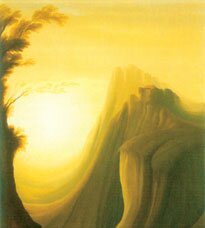
This month at the Istituto Italiano di Cultura, Ubaldo Bartolini, Italy's most famed traditional nature-view painter draws inspiration from Canadian poet Margaret Avison to create his new landscape series - The Optic Eye. But Bartolini's works, despite their tired subject matter, could only have been made in the 21st century.
On first inspection, the title of this exhibition implies a kind of redundancy - optic meaning 'of' or 'related to' the eye itself. But on a second glance, one sees that Ubaldo is highlighting in particular the artificial dimension to seeing. The eye, as instrument lodged in the body, has no judgment-free input of information. Bartolini's paintings of nature, while they reflect a masterful touch in high realism, speak less to the empirical presence of trees and fields and more to our human and religious attitudes about nature.
Like Margaret Avison, Bartolini taps into the specific moment with nature in a highly focused way. His paintings, like her poetry, make real not what exactly nature is - but how we might feel in a moment of being emotionally moved by it. She writes: "The body of this earth/has water under it and/over, from/ where the long winds sough tirelessly over water, or shriek around/ curved distances of ice." In making the banality of water a miraculous occurrence, she reminds us of the importance of perception. Once our mind has dulled from seeing water so many times, we can never again perceive it for the first time - unless that is, through a poem.
Bartolini's landscapes work on the viewer in a similar way. Romantic escapes show billowing clouds pulsating with hints of fluorescent. The figures meander insignificant beneath the grandiosity of the scene. Like Avison's poems, his paintings remind us that we are mortal and alive and only really in possession of this present moment, and so we should not take for granted this simple trickle of water or this fluorescent sunset.
Page 1/...Page 2
|
| Home / Back to Top |
|
|
 |
|
|



























 </ td>