|
Oct 28 - Nov 4, 2001 |
Presenting the Jewels of 1900
New book celebrates the great designers who made the world sparkle
Originally Published: 2001-09-23
 |
|
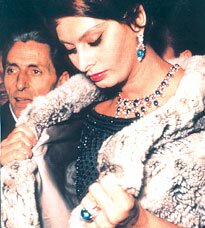
Sophia Loren in Bugari
|
Amber and emerald, rubies and semi-precious stones, lacquer and crystal, opal and turquoise, diamonds and amethysts, all valuable jewels in the whimsically creative hands of goldsmiths and artisans. Ingenious, avant-garde and unconventional in their abilities to couple modernity with tradition while embodying a hunger for innovation typical of restless, passionate societies and cultures and of their quest for vitality and fresh emotions. The art of jewellery and the signature jewel from the 1900s to today are celebrated in an impressive publication (edited by Giunti) that follows on the heels of a memorable exhibition held in Florence's Museo degli Argenti and presented by Marilena Mosco. The original exhibit was staged in an ideal venue: the Palazzo Pitti. The Medici's show-piece, with its polychrome, gold-speckled frescoes and carved ivory, precious metals and amber, is home to a unique jewellery collection that dates back to the 16th, 17th and 18th centuries. The items were collected by Anna Maria Luisa de Medici, the Palatine Electress and sovereign of Düsseldorf.
Alberto Carmi, president of Florence's "Ente Cassa di Risparmio," and organizer of the exhibition, explains: "A century of art filtered by the perspective of the jewel, the symbol of the tastes and style of an epoch: this is the opportunity to acknowledge the talented men and women who left their mark on fashion, brought on new trends and suggested guidelines and schools of thought." You want names? Buccellati, Cartier, Bulgari, Lalique, Van Cleef & Arpels, Tiffany. Each of them had a distinct and recognizable personal style. Their extraordinary artistic individualities enabled them to emerge and assert themselves. For example: Lalique was the first to establish himself using naturalistic themes similar to the motifs proposed by Eugène Grasset, a well-known illustrator of the time. Lalique's carvings often portrayed insects, birds, flowers and leaves and the artist would combine precious stones with humble and unusual materials such as glass, horn or even painterly techniques. Louis Comfort Tiffany, a descendant of the famous Maison, would say "the aesthetic quality of the jewellery of a people is indicative of their artistic ability. Each item must become a small-scale representative of art and must quietly attempt to convert the heathens." In time, the elucidation of that "manifesto" was presented in an unequivocal, fervid and devoted way.
Page 1/...Page 2
|
| Home / Back to Top |
|
|
 |
|
|