|
April 4 - April 11, 2004 |
Italy as a Cultural Superpower
Professor Riccardo Campa expands on legacy and importance of the Italian language
By Niccolò Marras
Originally Published: 2004-03-21
 |
|
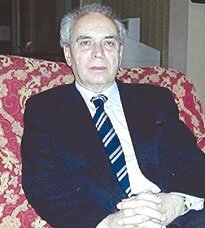
University of Udine professor Riccardo Campa
|
Language and culture can help us understand some phenomena of our time, such as the war in the Middle East, China's economic success, Colombo's discovery of America, or the future evolution of the world. Language and culture, then, are at the core of the development, and form the focus of some lectures given by Professor Riccardo Campa in Toronto.
Prof. Campa teaches at Siena's Università per Stranieri and chairs the Language and Publishing Committee of the Foreign Affairs Committee of the Italian Parliament. He was invited to lecture at the University of Toronto and other institutes.
He spoke about his lecture, titled "Historical Pathways of Italian Culture".
The opportunity was too good to be missed, and the professor himself, with his vast Mediterranean culture, was more than happy to clarify how economy alone can not always explain a conflict or a geographic discovery, or why the Italian language is so in fashion and its expression so appreciated by an ever-expanding world audience. We asked Professor Campa two questions, one about the future and another about the present.
Who will rule the world of tomorrow? Which language and which culture will impose themselves?
"The future is linked to the movements of man. The modern mentality entails change, i.e. changing jobs, countries, cities, and so on. Therefore, the winning languages will be those that can be contaminated. Spanish is one of these. It is thought that by 2020 most of the USA will speak Spanish."
What about Italian?
"Italian belongs to the archaeology of knowledge, something that new cultures absorb. It is changing and accepting contaminations. Spoken Italian is slightly different from written Italian, but its diffusion in Italy took place after the introduction of TV. The new language is slowly replacing all regional dialects."
What do you mean by archaeology, and what's the difference between spoken and written Italian?
"The Romance languages derived from Latin have lost the use of the subjunctive mode. Written Italian, on the other hand, was used by few well-educated people, so it stayed closer to Latin. That's why it gave a noticeable contribution to cultural development. Italian did not fade, due to this peculiarity of its written form, and accessed the pathways of thought, stocking up on culture and knowledge. The cultural and archaeological patrimony of Italy, amounting to 80 percent of Europe's and 60 percent of the world's, is a sort of 'stone book'. A good chunk of the world's culture is written on it, in words that cannot be erased. Italy is a great testimonial, a museum and at the same time a huge laboratory of knowledge. Studying the archaeology of the Italian language means discovering the origin of humanity. Clearly, the Italian language is the key to this knowledge,"
Page 1/...Page 2
|
| Home / Back to Top |
|
|
 |
|
|




























 </ td>