|
Dec 18,2005 - Dec 25,2005 |
At The Heart Of His Work
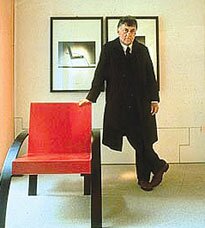
Late Italian architect Aldo Rossi created buildings of poetry before his accidental death
By Mark Curtis
Originally Published: 2004-01-18
The architecture of Aldo Rossi is inherently dramatic, so it's fitting that one of Rossi's best-loved works is a floating theatre which the Italian architect designed for the 1979 Venice Biennale. The architect, who died after a car accident near his northern Italian home in the late summer of 1997, once described his 250-seat Venetian theatre project, in his typically poetic manner, as "a place where architecture ended and the world of the imagination began."
Following Rossi's untimely passing, an American colleague, William Higgins, noted that "like his buildings, Rossi was at once serious and whimsical, magisterial and accessible, popular and retiring. Although an influential teacher and theoretician, he was at heart an artist and a visual poet, and that is the way he designed his buildings."
Although he began his career as modernism was reaching its zenith in Italy and around the world, Rossi was more of a traditionalist, inspired by the classical building forms of his native northern Italy. He refined his work by consciously returning to a select few number of forms, which included the cone, the chimney, the silo, the gable wall and the galleria. Rossi's disapproval of the limiting functional approach of modernism was evident in his 1966 book, L'Architettura della citta, which became an influential post-modern blueprint for urban planning.
In 1990, Rossi became the first Italian architect to receive the prestigious Pritzker Prize, generally acknowledged today as the top award for architecture worldwide. (Renzo Piano became the second Italian architect to receive the award in 1998.) In noting Rossi's achievements, the Pritzker Prize jury commented that "Rossi has been able to follow the lessons of classical architecture without copying them; his buildings carry echoes from the past in their use of forms that have a universal, haunting quality. His work is at once bold and ordinary, original without being novel, refreshingly simple in appearance but extremely complex in content and meaning."
Page 1/...Page 2
|
| Home / Back to Top |
|
|
 |
|
|



























 </ td>