|
Jan.2, 2005 - Jan.9, 2005 |
Remembering and celebrating
Columbus Centre's Joseph D. Carrier Gallery showcases dozens of Nativity scenes
By Jennifer Febbraro
Originally Published: 2003-12-28
There are many unsuspecting art collectors in this world. I'm thinking of my aunt Geenie, who has hoarded nativity scenes from every international vacation she's taken. Of course, this remains a seasonal exhibition, one which spills over mantels and onto decks of fireplaces, over elaborate dinner table spreads, ends up on bedside tables.
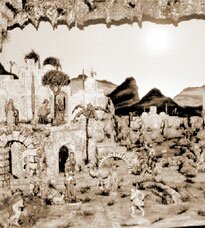
But as one walks through the labyrinth of miniature biblical figurines, a veritable Gulliver in his travels, two things become quite clear - one, the sheer pervasiveness of Christianity on a global scale and two, the variant expressions of that particular faith. This month at the Joseph D. Carrier Gallery, a monumental showcase of nativitys tells the story of this classic night, through the historical form of the manger - presepi.
Despite the fact that the replication of content - Jesus, Mary, and Joseph, and various animals - is, for the most part, consistent - the style, textures, and environs of the iconoclastic "stable" swing on the art pendulum between both high and low art. Remember in Love Actually, when Emma Thompson's daughter plays the "lobster" in attendance at the birth of Christ, never mind the octopus who almost misses the final hymn alongside the little drummer boy.
The first ever presepi came about as a theatre production of sorts. In 1223, St. Francis of Assisi created the first live nativity scene in the snow-covered Umbrian Hills. This was replicated as a tradition year after year until about a decade later when Rome's Church of Santa Maria Maggiore inaugurated the sculptural form of the presepi. This version still exists today.
The Joseph D. Carrier Gallery has none as ancient as this, but has an astonishing collection which traces the deep groove of faith which has crossed centuries of Christians. This year, over 40 new nativity scenes from South and Central America have been recently donated, adding to the already rich and diverse collection of nativitys reflecting the original Italian presepio, which consisted of small carved figures rendered with the general aesthetic of the eighteenth century. These Italian hand-made dioramas reflect the location of their makers, as one can see the shifts in landscape, vernacular architecture, and the daily activities of village life happening around the Christ legacy.
Page 1/...Page 2
|
| Home / Back to Top |
|
|
 |
|
|



























 </ td>