|
Dec.26/04 - Jan.2, 2005 |
15 - Italian-speaking art with weight
How cultural identity influences Italian expressions of visual art forms
By Antonio Maglio
Originally Published: 2003-04-06
 |
|
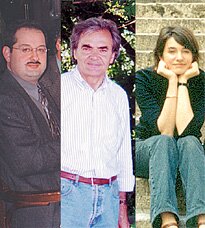
Luca Somigli, Silvio Mastrodascio and Laura Foster
|
International cuisine has an Italian language: panino, risotto, parmigiano, antipasto, and then pancetta (not bacon), focaccia, insalata, prosciutto, broccoli, tiramisu. These are just a few of the most frequently encountered words beyond the universal espresso, cappuccino, pasta, and pizza.
The Italian language is present in classical music as well: adagio, opera, fiasco, operetta, a solo, and soprano.
This is form, but there is also substance: Italian cuisine is an undisputed favourite, and Italian operas get constantly performed. Verdi, Puccini, Donizetti are audience favourites.
But what about figurative arts? Luca Somigli, Associate Professor of Italian Studies at the University of Toronto and director of the Frank Iacobucci Centre for Italian-Canadian Studies, believes there is an Italian language in figurative arts as well.
"Every art movement refers to the cultural tradition of the country where it manifests itself, and where it becomes a school: that's why talking of different languages in figurative art is absolutely correct," he says. "Let's consider two characters in comics: Tin-Tin and Corto Maltese. The first one speaks Flemish, the second speaks Italian. Tin-Tin's author Georges Remě, known under the pseudonym of Hergé, is among the most authoritative representatives of the so-called 'clear line', a school that developed mostly in Belgium but also in France: a sharp, essential, continuous trait. Corto Maltese's author Hugo Pratt is instead one of the top elements of Italian 'chiaroscuro', alongside Guido Crepax, the 'father' of Valentina."
What are their characteristics?
"Pratt and Crepax produced mostly in black and white, and used chiaroscuro in order to give depth to their panels. Their trait is realistic, concrete, in line with the Italian tradition of great authors and characters. Gianluigi Bonelli and Aurelio Galleppini, for instance, who drew Tex, Zagor, and Dylan Dog. Declaring that Bonelli's and Galleppini's Western comics are the best in the world is stating the obvious. That comic strip speaks Italian because it is the result of a tradition, a technique, a culture that developed in Italy."
Page 1/...Page 2
|
| Home / Back to Top |
|
|
 |
|
|



























 </ td>