|
Dec.26/04 - Jan.2, 2005 |
11 - How Italian Language Was Born
Professor Riccardo Campa emphasizes importance of maintaining la bella lingua
By Antonio Maglio
Originally Published: 2003-03-02
 |
|
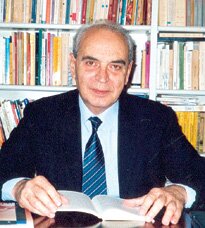
Riccardo Campa
|
Professor, can you explain the difference between the English and Italian languages? Riccardo Campa smiles, then replies: "With 25 words of English one can board a plane. With 25 words of Italian one goes nowhere."
Riccardo Campa, professor of History of Political Doctrines at Siena's University for Foreigners, is a sophisticated Italianist. He chairs the Language and Media Committee within the National Commission for the Promotion of Italian Culture Abroad, created by Italy's Ministry of Foreign Affairs in 1990. The very fact that the Commission lives symbiotically with the Ministry makes it a laboratory of cultural policy. Last year, it sent out to the diplomatic-consular network and to the Istituti Italiani di Cultura a sort of handbook with a very long title that states the strategy adopted by Italy: General guidelines for the promotion and diffusion of Italian culture and language abroad and for the development of international cultural co-operation.
Choosing at random among the priorities we find the promotion of activities linked to current Italian cultural production in every sector (visual arts, theatre, dance, music, cinema, etc.), the diffusion of the knowledge of Italy's huge artistic and archaeological patrimony, the strengthening of the diffusion of Italian language abroad in consideration of the raising demand coming from several countries and of the needs of our communities abroad. References for these and other goals will be the Regions, Provinces, municipalities, foundations and private companies. They also advocate a close relation with Italy's entrepreneurial world since exporting is not only an economic phenomenon but also has cultural significance.
From the operational standpoint, the handbook includes two main aspects: one deals with programmes allowing the creation of bursaries and chairs of Italian language and culture abroad and the establishment of youth exchanges; the other deals with the teaching of Italian, to be strengthened with a closer collaboration between Istituti Italiani di Cultura, Departments of Italian Studies of foreign universities, bilingual high schools and Italian schools abroad, Committees of the Dante Alighieri Society and institutions managing courses of Italian.
Page 1/...Page 2
|
| Home / Back to Top |
|
|
 |
|
|



























 </ td>