|
Dec.19 - Dec.26, 2004 |
6 - European Union helps Italian
Parliamentary deputy Gianni Pittella supports language expansion in world
By Antonio Maglio
Originally Published: 2003-01-26
 |
|
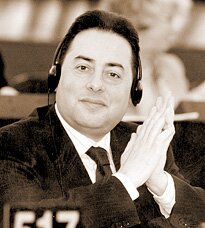
European Parliamentary deputy Gianni Pittella
|
In May 1984, the European Ministers of Education convened in Berlin (still split by the Wall). A unified Europe was little more than an embryo, rather a project still being worked at, and yet the governments felt the need to devise a joint cultural strategy to tackle the models coming mostly from the United States and Japan, which attacked the very essence of the Old Continent.
That need was the reason for the meeting, and this journalist was lucky enough to be assigned to cover that event.
More or less, the picture was like this: the United States was flooding Europe with movies, books, and also rivers of Coca-Cola (McDonald's was yet to come).
Japan sent forth the newest technologies but also comic books, like Heidi, whose stories were set in a Switzerland but had little reality to it as Heidi and her friends had been conceived and drawn in Tokyo.
All these products, foreign to European culture, were slowly exerting their influence on the everyday attitudes and consumption patterns of the Europeans, and the Old World had no solid alternative to offer.
For three days the ministers tried in vain to identify some. A communiqué full of commitments, resolutions and hopes, but lacking in proposals, concluded a meeting where nothing was actually decided. It was impossible; that still was the "Europe of Homelands" mentioned much earlier by De Gaulle, where the individual countries played the main roles.
Moreover the Wall was still cutting Berlin and Germany in half. On one side Federal Germany, allied with the NATO, on the other Democratic Germany, a satellite of the Soviet Union. The Wall cut Europe in half as well, leaving it short of some countries that had been decisive, in the past, for the construction of a common civilization. In addition to East Germany, Europe lacked Poland, Hungary, Czechoslovakia, and the Balkan and Slavic states: all of them were under the yoke of Moscow. How could a cultural strategy be devised while half of Europe's culture was daily deprived of its identity? The Iron Curtain weighed heavy on those years.
Page 1/...Page 2
|
| Home / Back to Top |
|
|
 |
|
|



























 </ td>