|
Oct 27 - Nov 3,2002 |
The Pharaohs arrive in Venice
Large Egyptian exhibition at Palazzo Grassi hails from 34 museums worldwide
Originally Published: 2002-10-06
 |
|
The head of Nefertiti
|
This month a much-anticipated exhibition opened its doors at Palazzo Grassi, in Venice, with some 300 pieces coming from 34 museums and private collections located in 12 different countries.
The most important testimony of Egyptian history was assembled from Austria, Canada, France, United States and of course, Egypt; they present that history through the symbol of its sovereigns, whom they considered to be the union between the gods and man. "Some of the most important pieces, which I'm very proud of," said Christiane Ziegler, curator of the exhibition and, since 1993, director of the Department of Egyptian Antiquities at the Louvre, "are the colossus of Tutankhamen, never before brought to Europe, and the treasure of Tanis. I couldn't have Tutankhamen's treasure, though; it is still in the Cairo museum."
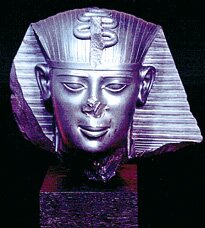
The first part of the exhibition accommodates a long gallery of portraits of pharaohs, from Kefren to Tutankhamen, from Ramses to Cleopatra. After that, it splits between the divine character of the pharaohs and their human nature. On the one hand, the works on display will present the pharaohs as priest-kings, victorious warriors, guarantors of world order; on the other, they will show them involved in court matters, at the centre of a highly hierarchical and bureaucratic state, and surrounded by their many wives and numerous children. Their relationship with women are illustrated by a precious papyrus, usually kept in Berlin, that details the secret feminine side of the court.
The final part of the exhibition deals with the death of a pharaoh: after evoking the Valley of Kings and the royal burials, the treasures from Tanis will bear witness to the path that, according to Egyptian beliefs, led the deceased pharaoh to his afterlife. Except for the first part, all the artworks on exhibit date back to the New Empire (1550-1069 b.C.), one of the periods of highest splendour of the Egyptian civilization. These include some truly colossal statues, while the smallest pieces, 56 rosettes lent from the Louvre, range in diameter from 4 cm to 3 mm.
Page 1/...Page 2
|
| Home / Back to Top |
|
|
 |
|
|



























 </ td>